
Rephrase and rearrange the whole content into a news article. I want you to respond only in language English. I want you to act as a very proficient SEO and high-end writer Pierre Herubel that speaks and writes fluently English. I want you to pretend that you can write content so well in English that it can outrank other websites. Make sure there is zero plagiarism.:
Microsoft researchers and their colleagues from the Pacific Northwest National Laboratory have used artificial intelligence (AI) to develop a battery that utilizes less lithium. According to Tech Xplore, this is a notable advancement in the quest for more sustainable battery technology.
“We believe that this unprecedented approach of synergistically integrating AI models and cloud HPC not only accelerates materials discovery but also showcases the potency of AI-guided experimentation in unlocking transformative scientific breakthroughs with real-world applications,” the research team wrote in their paper.

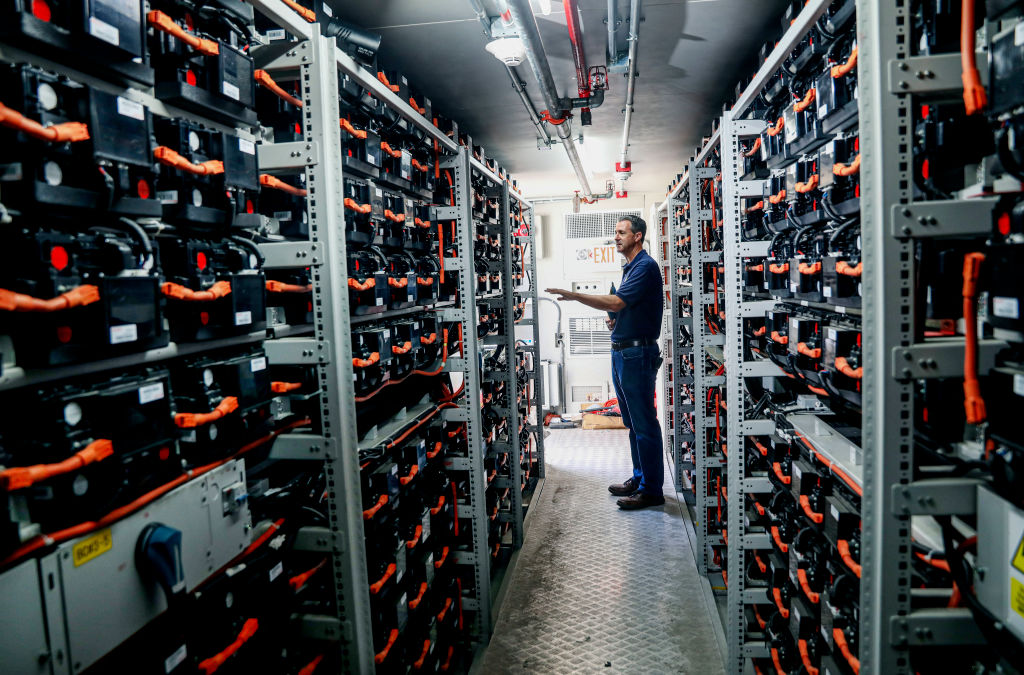
Mike Ferry, with the University of California San Diego Center for Energy Research, shows a bank of Lithium Ion batteries at UCSD on September 16, 2022 in La Jolla, California. – Dire predictions of blackouts in California during this month’s fearsome heat wave never came to pass, with technology — and a dose of community spirit — helping the creaking electricity grid through its most testing period ever.
The Promise of Batteries With Less Lithium
It is worth noting that lithium-ion batteries are prevalent in both electronic devices and electric vehicles. They are also integral to the transition toward a greener electric grid.
However, the high cost of lithium has prompted researchers worldwide to explore alternatives. The team at Microsoft, seeking to reduce the lithium content in batteries, harnessed the power of AI to accelerate the process.
Traditionally, such endeavors require an extensive timeframe, spanning several years. To expedite the search, the research team used AI, which excels in processing massive datasets to learn and optimize processes.
AI Analyzes Millions of Candidates
The AI model was designed to analyze millions of potential materials that could replace some lithium content in batteries. It assessed factors such as stability and the behavioral aspects of batteries employing different materials.
Through this AI-driven strategy, the research team efficiently narrowed the list of potential candidates to a few hundred options. The Microsoft team collaborated with materials scientists at Pacific Northwest National Laboratory to refine the selection further.
Following their advice, the researchers implemented more specific screening criteria and additional elimination rounds, ultimately identifying a promising candidate. Their innovative approach involved substituting approximately half of the lithium atoms in a battery with sodium atoms.
Read Also: Microsoft’s $76 Million Investment Transforms Wisconsin Pumpkin into Massive Data Center Campus
32 Million Candidates
The abstract of the study highlights the significance of combining AI and traditional physics-based models on high-performance computing (HPC) resources in accelerating the discovery of materials. The researchers navigated over 32 million candidates, predicting half a million potentially stable materials.
Focusing on solid-state electrolytes for batteries, they pinpointed 18 promising candidates, highlighting the effectiveness of AI-guided experimentation in unlocking significant scientific breakthroughs with practical, real-world applications.
The team emphasized that this integration of AI and cloud HPC represents a harmonious approach to materials discovery, providing insight into the future of accelerated scientific progress. The findings of the research team were published in the preprint server arXiv.
Related Article: AI Takes Center Stage in Davos 2024 With World’s Biggest Companies Promoting Their AI Products

ⓒ 2023 TECHTIMES.com All rights reserved. Do not reproduce without permission.


