

For most of the past decade, the quantum threat to cryptocurrency sat in the “someday” column. This year it moved closer.
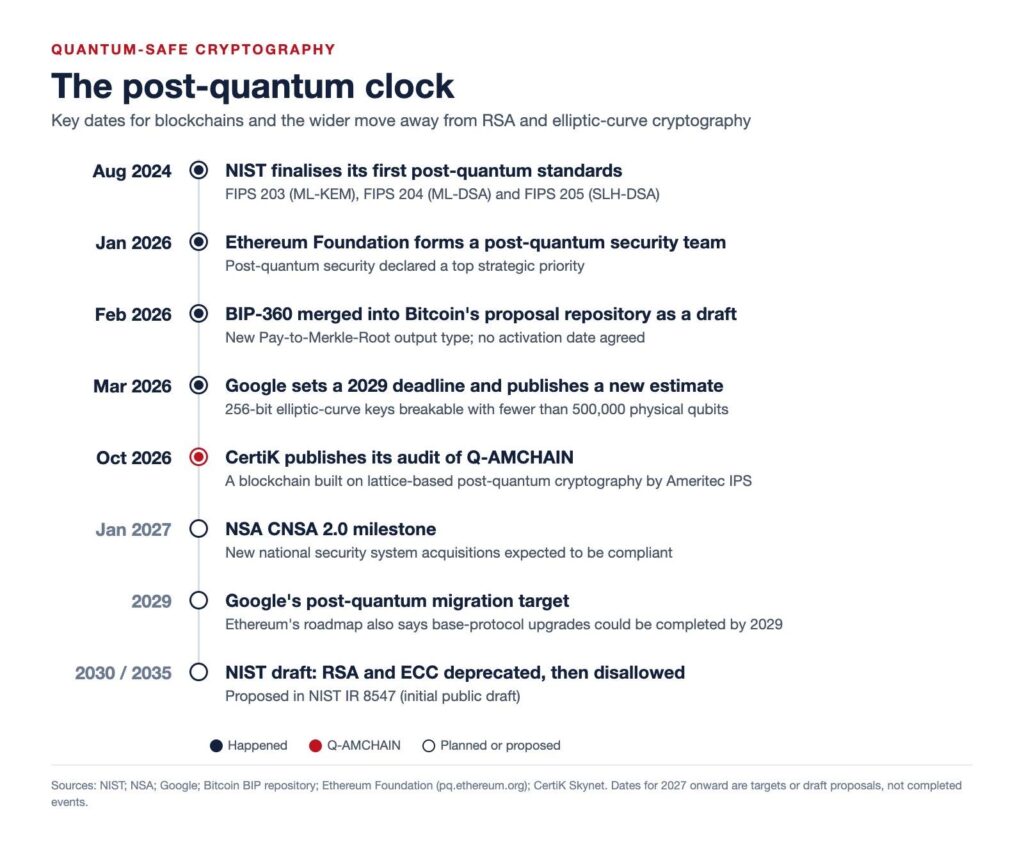
On March 31, Google’s Quantum AI team published a 57-page paper estimating that the elliptic-curve cryptography (ECC) behind Bitcoin and Ethereum wallets could be broken with fewer than 500,000 physical qubits, in a runtime measured in minutes rather than days. Earlier estimates ran into the millions. Ethereum researcher Justin Drake and Stanford cryptographer Dan Boneh were among the co-authors. A week before, Google had set the end of 2029 as its own deadline for moving its products to post-quantum cryptography (PQC).
No quantum computer that size exists yet. But the gap between theory and hardware keeps narrowing, and public blockchains are notoriously slow to change.
How the Biggest Networks Are Responding
Bitcoin’s leading proposal is BIP-360, written by developers Hunter Beast and Ethan Heilman. It was merged into Bitcoin’s improvement proposal repository in February as a draft. It defines a new output type, Pay-to-Merkle-Root, which drops the Taproot key-path spend that leaves a public key visible on-chain. It also lays the groundwork for post-quantum signature schemes to be added later through separate soft forks. A merge is not an endorsement, and no activation date has been agreed.

Ethereum has moved faster on organisation. In January, the Ethereum Foundation formed a dedicated post-quantum security team led by Thomas Coratger, and Drake said the foundation had declared PQ security a “top strategic priority”. Its public roadmap says upgrades to the base protocol could be completed by 2029, with the full move of user accounts taking years longer. The quantum-resistant algorithms under evaluation include Falcon, Dilithium and SPHINCS+.
Why Retrofitting Is Hard
Upgrading a live blockchain is nothing like patching a server. Every holder has to move funds to new addresses, and coins whose owners have lost their keys cannot move at all. That has opened an uncomfortable debate among Bitcoin developers. A second draft, BIP-361, co-written by Jameson Lopp, would eventually freeze coins that are not moved to quantum-resistant addresses. Critics call that confiscation, while Lopp has said he wrote it because he dislikes the alternative even more.
Size is another problem. Post-quantum digital signatures are much larger than today’s, which puts pressure on block space and fees.
Starting From the Other End
Q-AMCHAIN, a blockchain developed by Ameritec IPS of Irving, Texas, takes the opposite route. Rather than adding quantum resistance to an existing network, it uses lattice-based post-quantum cryptography for identity, signatures and encryption as part of its base design. Lattice-based schemes are the family behind ML-KEM and ML-DSA, two of the three PQC standards NIST finalised in August 2024.
Its consensus layer, Forest Protocol, is described as a leaderless, staked DAG. The project’s technology page also mentions “hybrid compatibility strategies” for phased migration, an acknowledgement that a new chain still has to connect with older systems. In October, CertiK published its audit of the chain’s code, which lists 79 findings across 145 files. All but one were resolved, including the five rated critical.
The Trade-Off
A clean start has obvious appeal. There are no legacy addresses with exposed public keys and no dormant coins to argue over. But a new network also lacks what Bitcoin and Ethereum have spent years building: liquidity, large developer communities and a long record of surviving attacks. Q-AMCHAIN’s performance claims, up to 30,000 transactions per second in optimised benchmark conditions, have yet to be tested at public scale.
The two approaches may meet somewhere in the middle. The large networks will keep upgrading in stages, while newer chains try to prove that quantum-resistant design works in practice. NIST’s draft transition guidance proposes that quantum-vulnerable algorithms such as RSA and ECC be deprecated after 2030 and disallowed after 2035. Whichever route a network takes, it is now working against roughly the same clock.
Q-AMCHAIN’s design is outlined on its technology page, and its developer, Ameritec IPS, also builds post-quantum storage and biometric identity products.


